
Inflation, Rising Rates, and Your Retirement: How New England Homeowners Can Put Home Equity To Work

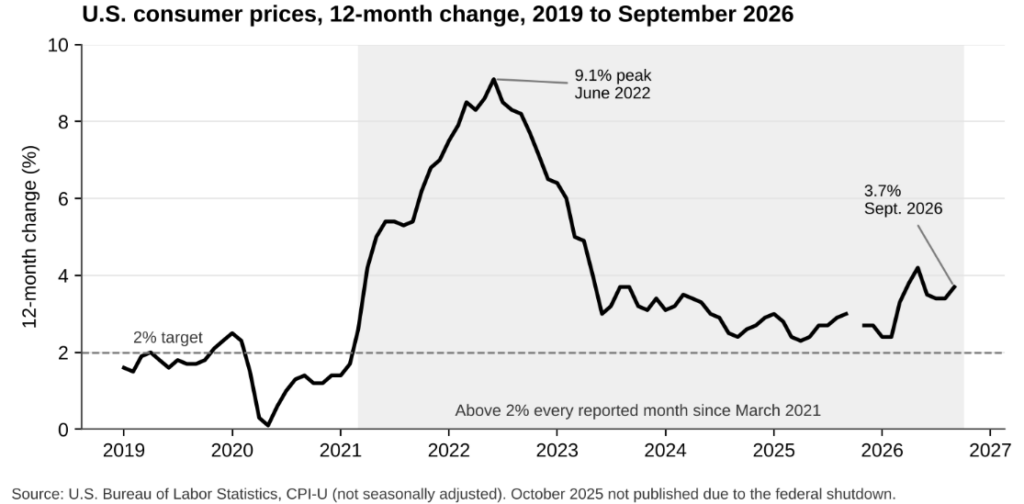
Over the last five years, inflation has quietly raised the price of nearly everything. Consumer prices rose 3.7% in the 12 months ending September 2026, and inflation has stayed above the Federal Reserve’s 2% target in every reported month since March 2021. In the Boston area, prices rose 3.8%, driven by a 21.7% jump in energy costs.
For retirees living on fixed incomes and conservative investments, that steady erosion adds up. At the same time, many older Massachusetts homeowners are sitting on more home equity than ever before.
This article looks at where inflation and interest rates are headed, what that means for retirees, and how a reverse mortgage loan, especially a reverse mortgage line of credit, can help turn home equity into a hedge against rising costs.
Inflation Has Run Above Target for More Than Five Years
TInflation peaked at 9.1% in June 2022, eased to 2.3% by April 2025, then climbed again in 2026 as energy prices surged. In the year ending September 2026, gasoline prices rose 34.2%, and fuel oil prices rose 74.2%.
The bottom line for retirees: With consumer prices up 29% since 2020, $100 today buys about $23 less of what you need than six years ago.
What’s Ahead? Cooling, but Not Quickly
Most forecasters expect prices to keep rising faster than normal this year, then trend downward over the next two years until they hit the usual 2% level.
- Private economists, surveyed by the Philadelphia Fed, predict about 3.6% in 2026 and 2.3% in both 2027 and 2028.
- The Federal Reserve expects inflation of about 3.7% in 2026, dropping to around 2.3% in 2027 and 2.1% in 2028.
Why Inflation Hits Retirees the Hardest
Working households can cut costs or take on debt, expecting wages and the market to catch up over time. Retirees don’t have this luxury.
- Cost-of-living adjustments (COLAs) often lag behind rising costs, and many pensions adjust only partially. For 2027, Social Security’s COLA is 3.6%, just below September’s 3.7% inflation rate.
- Conservative assets like CDs and savings accounts protect your principal, but their returns may not keep up with inflation. Bonds you already own can lose value when interest rates rise.
- Heating costs hit New England hard in the best of times. This winter, heating oil bills are expected to rise 21%, to an average of $2,115.
What Can Help Retirees? Record-High Home Equity.
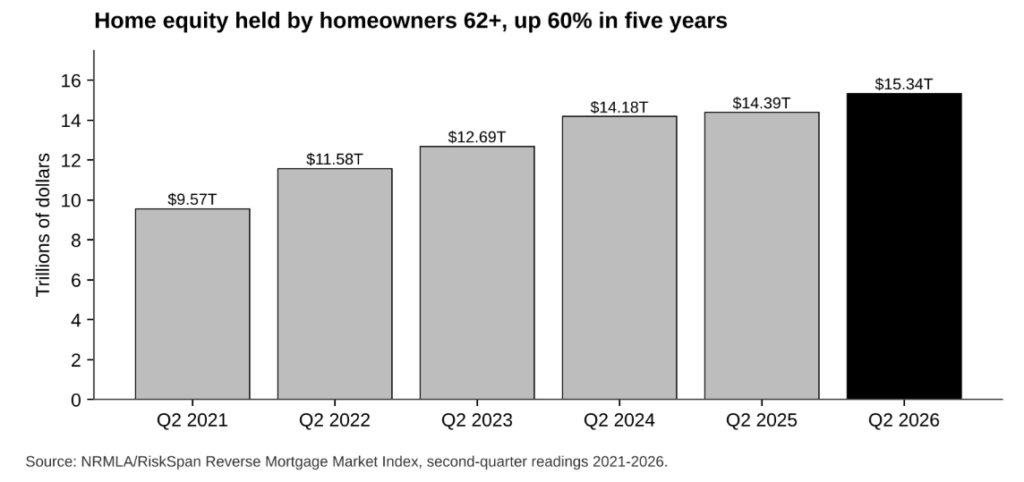
While inflation eats away at cash and fixed incomes, it also raises property values. In fact, homeowners 62 and older held a record $15.34 trillion in home equity in the second quarter of 2026, up 60% from $9.57 trillion five years earlier.
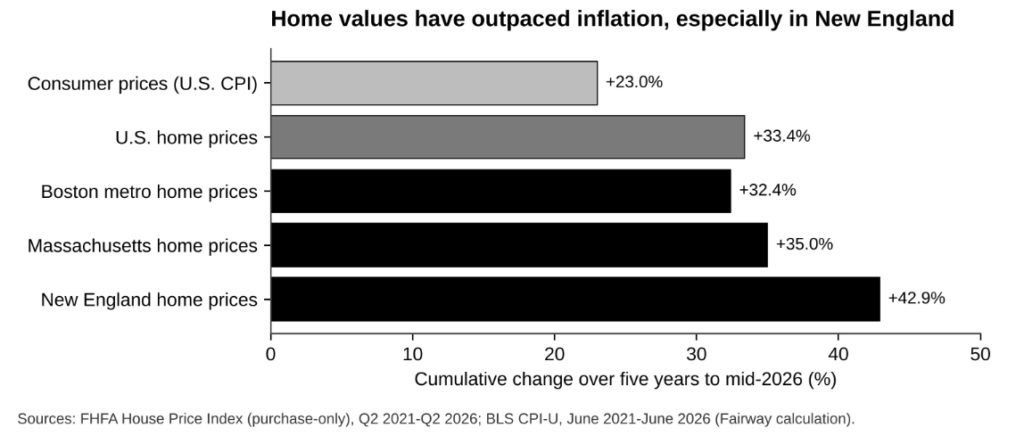
Homeowners in New England have done better than most. Over the five years ending mid-2026, home prices rose 35% in Massachusetts and 42.9% across New England, compared with a 23% increase in consumer prices.
The numbers are large at the household level, too. Among Massachusetts homeowners who took out an FHA-insured reverse mortgage in the past year, the median home value was $642,500, about 46% higher than the national median of $440,000.
For many New England retirees, that creates an unusual position: income that buys less every year, alongside home equity that has grown faster than inflation. The question is how to put some of that equity to work without selling the home.
How a Reverse Mortgage Can Help New England Retirees Counter Inflation
A Home Equity Conversion Mortgage (HECM) is an FHA-insured reverse mortgage for homeowners 62 and older. It converts part of your home equity into funds you can use, with no monthly mortgage payments required as long as you live in the home, pay property taxes and homeowners insurance, and maintain the property. Here are five ways it can help when prices keep rising.
1. Remove a Big, Fixed Monthly Expense
If you still have a mortgage, a reverse mortgage can pay it off, freeing up that monthly payment for other expenses. You simply need to pay property taxes, insurance, and home maintenance. Read this quick blog post to see how to eliminate your monthly mortgage payment.
2. Open a Line of Credit That Grows
This is where a reverse mortgage stands out when inflation and interest rates are high. With an adjustable-rate HECM, you can set aside some or all of your proceeds as a line of credit. The unused portion grows over time at the same rate as the loan balance. Because the rate is adjustable, the growth rate rises when interest rates rise.
Growth increases the amount you can borrow, not the cash in your pocket, and any funds you draw accrue interest. Unlike a typical home equity line of credit (HELOC), a HECM line of credit can’t be frozen, reduced, or canceled because of market conditions, as long as you meet the loan terms. See how a HECM line of credit compares with a HELOC.
3. Protect Your Portfolio From Selling at the Wrong Time
Inflation and rising rates can bring market volatility. A line of credit gives you another source of funds in a down year, so you don’t have to sell stocks or bonds at a loss. Research published in the Journal of Financial Planning found that drawing on a reverse mortgage line of credit after down years, rather than saving it as a last resort, substantially improved the odds that a retirement portfolio would last 30 years. Learn more about how to protect your portfolio and the HECM lifeboat strategy.
4. Cover the Costs That Rise Fastest
Energy, healthcare, and home repairs often rise faster than overall inflation. Reverse mortgage funds can help pay a winter heating bill, medical and in-home care costs, or home improvements such as an upgraded, energy-efficient heating system.
5. Add Steady Monthly Payouts
You can also choose to receive monthly payments for as long as you live in the home (tenure) or for a set number of years (term). Monthly payment amounts are fixed and don’t adjust for inflation, so many borrowers pair them with a line of credit. Learn more about how to enhance your cash flow, or read Your Home’s Hidden Safety Net: Using Equity to Weather Economic Storms for even more useful tips.